

What Happens When You Resell Off-Plan Property in Dubai?
Reselling before handover means more than agreeing on a price. Understand developer approval, registration, remaining installments and the costs that affect your actual return.
You bought an apartment on paper. The tower is rising, the area is buzzing, and someone has offered you more than you paid. Can you sell it before handover?
In Dubai, an off-plan property can be resold, provided the transaction meets the applicable registration requirements, contractual conditions and required approvals. What matters is understanding what you own, what remains payable and what must happen before a new buyer can take over.
Here is what actually happens when you resell off-plan property in Dubai—and how to work out what you may receive after the costs.
What Are You Selling Before Handover?
When you buy off-plan, you do not receive the final title deed right away. The purchase is recorded in the Dubai Land Department’s interim register, through the Oqood system. DLD’s initial sale registration service describes how developers register off-plan units and issue provisional registration records.
When you resell before completion, you are transferring your registered contractual interest rather than handing over a finished home. The transaction is often described as an off-plan assignment. The developer must confirm how the buyer will take over the outstanding obligations.
Article 6 of Dubai’s Law No. 13 of 2008 provides for the sale and other legal dispositions of off-plan units entered in the interim register. A private agreement alone is not a substitute for completing the required registration.
If this is your first purchase, our first-time buyer’s guide to Dubai off-plan property explains the wider ownership journey.
Understand Your Developer’s Payment Threshold
Do not assume that an off-plan unit can be resold immediately after reservation. Your Sale and Purchase Agreement (SPA) and the developer’s applicable transfer policy may require a specified proportion of the original price to be paid, alongside other conditions.
A figure such as 30% or 40% should not be treated as a universal Dubai rule. Confirm the requirement for your specific unit in writing, including how it interacts with any applicable legal or registration requirements.
Before marketing the property, ask the developer:
- Is the unit currently eligible for resale or assignment?
- How much must be paid before approval, and are all installments up to date?
- Which documents and approved administrative charges apply?
- Can the buyer take over the existing payment plan, and on what terms?
- Which registration channel and approval sequence should be followed?
Review the resale, assignment and transfer clauses before accepting a deposit or promising a completion date.
How to Resell Off-Plan Property in Dubai
- Check your eligibility. Obtain the current statement of account, confirm the unit’s registration details and identify any overdue payments, financing or restrictions.
- Find your buyer. If using an agent, verify their license and registration, and ask them to confirm the required advertising permissions. Compare realistic completed transactions rather than relying only on asking prices.
- Agree on the sale or assignment documents. These may include Form F where applicable, together with developer-specific paperwork. Record the price, deposit arrangements, payment deadlines, fee allocation and what happens if an approval is not obtained. The documents should explain how the remaining installments will be handled.
- Obtain the required developer approval or NOC. A No Objection Certificate confirms the developer’s approval for the relevant transaction. Ask about validity, conditions and processing time; do not assume approval is automatic.
- Complete the registration and settlement. Follow the developer’s and DLD’s applicable procedure, which may involve a Registration Trustee or the relevant registration system. Confirm the updated interim registration, buyer details and payment obligations before treating the transfer as complete.
Keep the signed agreements, statements, payment receipts and registration confirmation together. Our off-plan payment and booking-fee checklist explains why verified payment instructions and records matter.
The overall process depends on finding a suitable buyer, obtaining approvals, arranging funds and completing registration. Allow for several stages rather than treating a two-to-four-week estimate as a guaranteed timeline.
Understanding Your Equity and Resale Premium
Understanding how payments are handled is an important part of reselling an off-plan property. The arrangement commonly involves three components, all subject to the agreed transfer terms.
1. Recovery of Your Initial Investment
The buyer’s payment to you may reimburse the amount you have already paid toward the original purchase price. This is recovered capital, not profit. Check the developer’s statement of account against your receipts.
2. The Resale Premium
If the agreed resale price exceeds the original purchase price, the difference is the gross premium. It represents potential upside before transaction expenses and any applicable tax—not a guaranteed net gain.
3. Transfer of the Remaining Payment Plan
The buyer assumes the outstanding installments only through the approved transfer arrangements. Do not assume your obligations end simply because you have signed an agreement with the buyer or received a payment.
In simple terms, your gross settlement may include recovered capital plus an agreed premium, while the buyer takes over the approved remaining obligations. Your actual investment return must also account for acquisition costs, selling costs, financing costs and any other applicable liabilities.
What Does It Cost to Resell?
Ask for an itemized cost estimate before agreeing on the final price. The allocation of costs should be recorded in the relevant contracts.
| Cost | What to verify | Who pays? |
|---|---|---|
| Developer NOC | Current approved charge, any VAT and certificate validity | Confirm the applicable terms and agreed allocation |
| Developer administration | Applicable DLD-approved charges; request a written breakdown | Confirm before signing |
| DLD sale registration | The published sale-registration schedule lists 2% for the seller and 2% for the buyer | Check the applicable route and any agreed contractual allocation |
| Agent commission | Commission and applicable VAT under the brokerage agreement | As agreed in writing |
| Trustee or service-partner charges | Current charges for the transaction’s registration channel, plus VAT where applicable | As applicable and agreed |
| Financing or other costs | Any lender release, settlement, representation or outstanding-payment charges | According to the relevant agreements |
DLD’s published property sale registration fees total 4% of the sale value, split as 2% for the seller and 2% for the buyer. If your agreement allocates the cost differently, confirm that arrangement and the applicable charges with the registration provider. Do not automatically assume the buyer pays everything.
The percentage calculation relates to the registered resale value, not simply the original purchase price. Confirm the amount accepted for registration and any additional charges for the specific off-plan transaction.
Developer charges are not unrestricted: Article 7 of the law linked above limits sale, resale and other disposition charges to DLD-approved administrative costs. Do not assume that a percentage-based developer transfer charge is valid merely because it appears in a quotation.
A Worked Example: Capital, Premium and Remaining Installments
Imagine you bought an apartment for AED 2,000,000 and have paid 40%, or AED 800,000. Assume the unit is eligible for an approved transfer and a buyer agrees to a resale price of AED 2,300,000.
- The original balance due to the developer is AED 1,200,000.
- The gross premium is AED 300,000: AED 2,300,000 minus AED 2,000,000.
- Under the illustrative arrangement, the buyer pays you AED 1,100,000 before your costs: AED 800,000 of recovered capital plus the AED 300,000 premium.
- The buyer takes over the AED 1,200,000 balance through the approved transfer terms.
- A 4% registration-fee calculation on AED 2,300,000 equals AED 92,000 in total. The relevant fee schedule and agreement determine how that cost is allocated.
The AED 1,100,000 is not all profit. Even the AED 300,000 premium is a gross figure. Deduct your own selling expenses and account for original acquisition expenses, financing and any applicable tax when assessing the overall return.
These figures are illustrative, not an offer, valuation or assurance that a property will achieve a premium. Keep your ongoing ownership budget realistic too; our apartment running-cost guide covers expenses that can continue while you wait to sell.
What Makes an Off-Plan Property Attractive for Resale?
The foundations of a property purchase are established long before the time comes to sell. Whether your intention is to seek a future resale or hold for longer, consider:
- A developer’s track record. Review delivery history, communication and documented progress rather than relying only on marketing.
- A location with enduring appeal. Consider connectivity, accessibility and the lifestyle infrastructure of the surrounding neighborhood.
- Clarity from the outset. Review the SPA, payment milestones, approved charges and transfer conditions before committing.
- Design that supports everyday living. Consider layouts, construction quality and practical features alongside architectural identity.
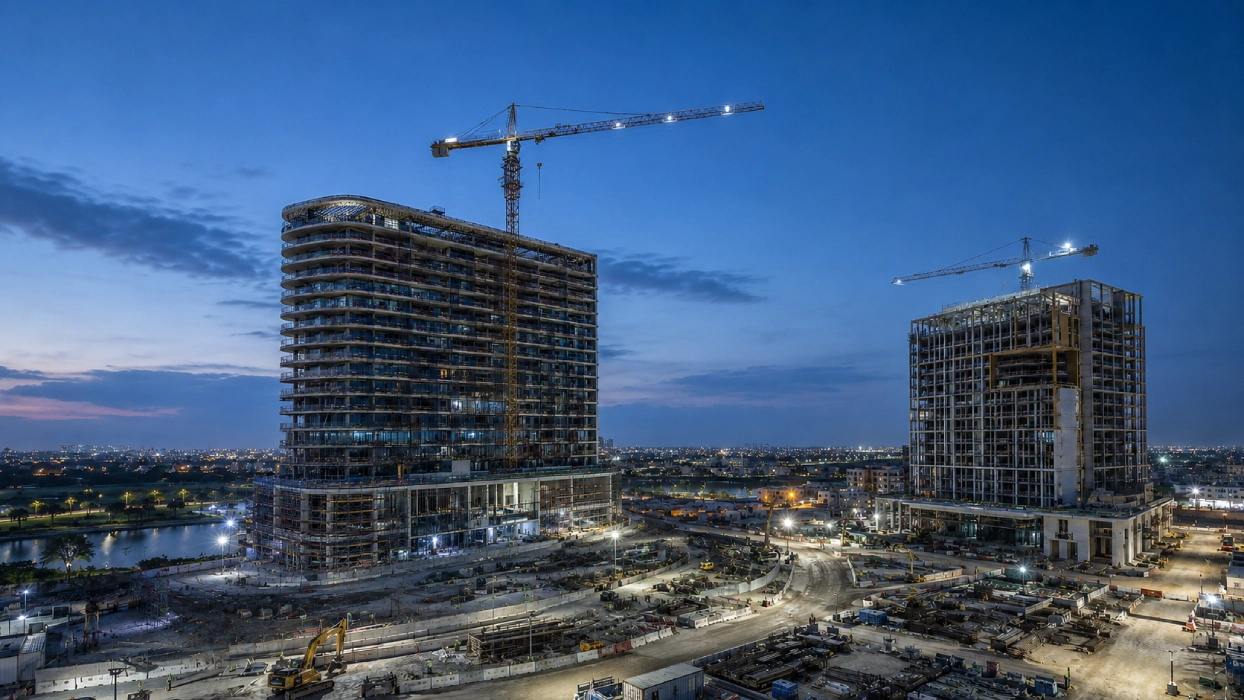
Construction progress can influence a buyer’s assessment of the remaining commitment. Check current official project records and developer updates, rather than treating a rendering or an old photograph as proof of the site’s present condition. Prestige One’s construction updates provide a starting point for its published project progress.
Across Prestige One’s portfolio, different locations create different residential settings. Hilton Residences Dubai Maritime City combines a waterfront location with Hilton’s hospitality heritage, while FAUCHON Résidences introduces French-inspired branded living in Jumeirah Garden City. These are examples of project positioning, not guarantees of resale demand or investment returns.
Do You Pay Tax When Reselling Off-Plan Property?
Tax treatment depends on who holds the property and the nature of the activity. Avoid assuming that every resale is automatically tax-free or that the whole premium will be retained.
The Federal Tax Authority’s guidance on real estate investment by natural persons explains the exclusion from UAE Corporate Tax for qualifying real estate investment income where the activity is not conducted, or required to be conducted, through a business license.
A property held through a company, or as part of a licensed business activity, may be treated differently. Cross-border tax obligations may also arise depending on your tax residence and circumstances. Obtain advice specific to your situation before relying on a particular tax outcome.
Five Things to Consider Before Selling
- Read your SPA first. Identify the transfer conditions, required payments and applicable charges before you list the property.
- Stay current on payments. Confirm your account balance and resolve discrepancies before applying for approval.
- Understand the buyer’s funding. Establish whether the purchase is cash-funded or financed, and which approvals are needed. Do not assume a bank will finance a particular assignment.
- Address any existing finance. Obtain the lender’s required consent and release or settlement instructions. Confirm how its interest will be dealt with as part of the transfer.
- Price realistically. Premiums are never guaranteed. The property, competing supply, construction progress and buyer circumstances all affect the outcome.
The Bottom Line
Reselling off-plan in Dubai begins with checking eligibility and ends with an approved, registered transfer—not simply a signed agreement between two buyers. Confirm the developer’s conditions, keep your payment records current and understand the complete settlement before agreeing on a price.
At Prestige One Developments, informed decisions are an important part of property ownership. Explore the Prestige One portfolio or connect with our team for official project information, while seeking independent advice on your resale and tax arrangements.
Frequently Asked Questions
Can I sell my off-plan property before handover in Dubai?
Registered off-plan units can be resold, subject to the applicable legal requirements, developer approvals and contractual conditions. Confirm your unit’s eligibility and the required registration process before committing to a buyer.
How much do I need to pay before I can resell?
Confirm the threshold for your particular unit with the developer and your SPA. Do not treat 30% or 40% as a universal legal requirement across Dubai.
Who pays the DLD registration fee on a resale?
DLD’s published property-sale schedule lists 2% for the seller and 2% for the buyer. Check the applicable registration route and record any agreed allocation clearly in the transaction documents.
How long does an off-plan resale take?
There is no single timeline for the whole transaction. Finding a buyer, obtaining the NOC or other approvals, arranging financing and completing registration can each affect the schedule. Obtain a realistic timetable for your specific case.
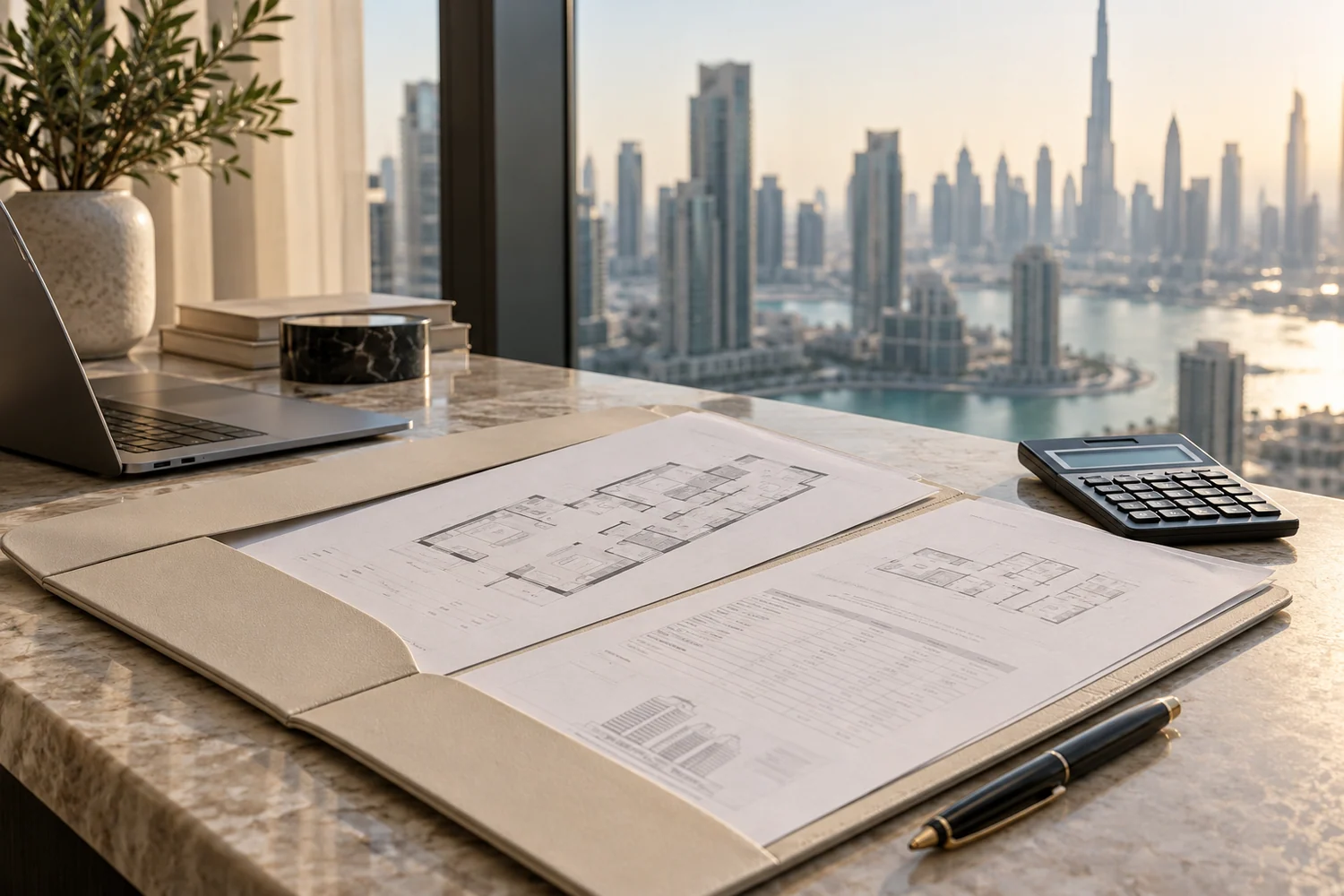
This article is general information, not personalized legal, financial or tax advice. Fees, procedures and developer policies may change. Confirm the current terms with your developer, DLD and qualified advisors. The featured and document-review images are AI-generated editorial illustrations, not photographs of an actual property transfer or a specific Prestige One development. The construction image is an existing Prestige One website asset, shown for illustration.
More Stories



Discover what comes next
Explore our developments or speak with our team for more information.