
Dubai Cashless Strategy Beats Its 2026 Target: What It Means for Residents and Businesses
Dubai’s cashless transactions index has reached 90.1%. Official October updates show how digital payments are becoming part of the city’s business infrastructure.
Dubai has passed a major milestone in its transition towards digital payments. On 9 October 2026, Dubai Finance announced that the emirate’s cashless transactions index had reached 90.1%, exceeding the strategy’s 90% target for 2026 ahead of its two-year timetable.
The results, reported by Emirates News Agency (WAM), show progress across the city’s payment ecosystem. A separate Dubai Customs update published on 15 October adds a more detailed picture of digital adoption in trade services.
What Dubai’s October 2026 Cashless Results Show
Dubai Finance’s final strategy report recorded several distinct indicators:
- 90.1%: Dubai’s cashless transactions index, against a 90% target.
- 100%: the government sector’s Digital Enablement Index.
- 99.66%: government cashless collections during the first half of 2026.
- 90.1%: the community happiness index, also above its 90% target.
The report also attributed more than AED 8 billion in economic contribution to cashless payment initiatives. This is a reported contribution to the emirate’s economy, not a figure for government fee collections. The National’s 9 October coverage also reported the milestone and its economic significance.
Different Indicators Measure Different Things
The citywide cashless transactions index should not be confused with government collections or the availability of digital payment channels. In particular, a 100% government Digital Enablement Index does not mean that every payment throughout Dubai is already cashless.
Dubai Customs Adds a Trade-Sector Update
Dubai Customs reported that 99.3% of its payment transactions were cashless in the first half of 2026. It separately recorded 99.6% digital channel adoption and a 98% happiness index for its digital services.
The authority completed 23 million customs transactions during the same six months. Its announcement explicitly distinguishes that operational total from the number of cashless payment transactions: they are not the same measure.
These are first-half operating results announced in October, rather than a claim that 23 million cashless payments took place during October alone. Dubai Customs links its work to more integrated service, payment and control processes.
A Strategy for Government and Private-Sector Payments
The official Dubai Cashless Strategy website identifies the initiative as a Dubai Finance-led programme launched in October 2024. Its original ambition covered transactions across both government and private sectors, supported by three pillars: Digital Governance, Digital Innovation and Digital Society.
The programme is about secure, inclusive access to digital payments as well as adoption. Its published framework includes participation by government bodies, banks, payment providers and other businesses, rather than relying on a single app or payment method.
Building Business Readiness
A separate agreement announced by the Dubai Government Media Office on 6 January 2026 brought Dubai Finance and the Dubai Free Zones Council together to advance digital payment initiatives. The cooperation covered expertise, data and analytics, financial technology and awareness activities. This earlier agreement provides context for the October results; it is not a newly announced October measure.
Why Residents and Businesses Should Pay Attention
Our editorial assessment is that payment infrastructure belongs alongside transport, utilities and connectivity when considering how a city works day to day. The relevance is practical: how people access services, complete payments and keep records, and how businesses fit those steps into their operations.
For households, digital convenience does not remove the need to budget. Our guide to the cost of running an apartment in Dubai examines the underlying expenses, while Your First 90 Days in a New Dubai Home covers settling into a new address.
For companies researching an office location, payment services are one part of a much wider decision that also includes access, space requirements and operating costs. Explore The One by Prestige One alongside our Barsha Heights destination guide for location context, not as evidence of a particular payment facility.
What the Milestone Does Not Establish
The reported figures do not establish a new citywide ban on cash, nor do they confirm that a particular landlord, developer or service provider accepts a specific card, wallet or digital asset. Check the accepted payment channel directly with the relevant organisation.
They also do not change the terms of an individual property agreement or guarantee higher prices or rental returns. Buyers should continue to verify project records, payment instructions and contractual terms. Our off-plan booking-fee checklist explains those checks, and our DLD property-registration platform update covers a separate digital initiative within real estate.
Dubai’s latest cashless results are best understood as a service-infrastructure milestone: measurable progress in digital payments, with practical implications for residents and businesses, rather than a property-market forecast.
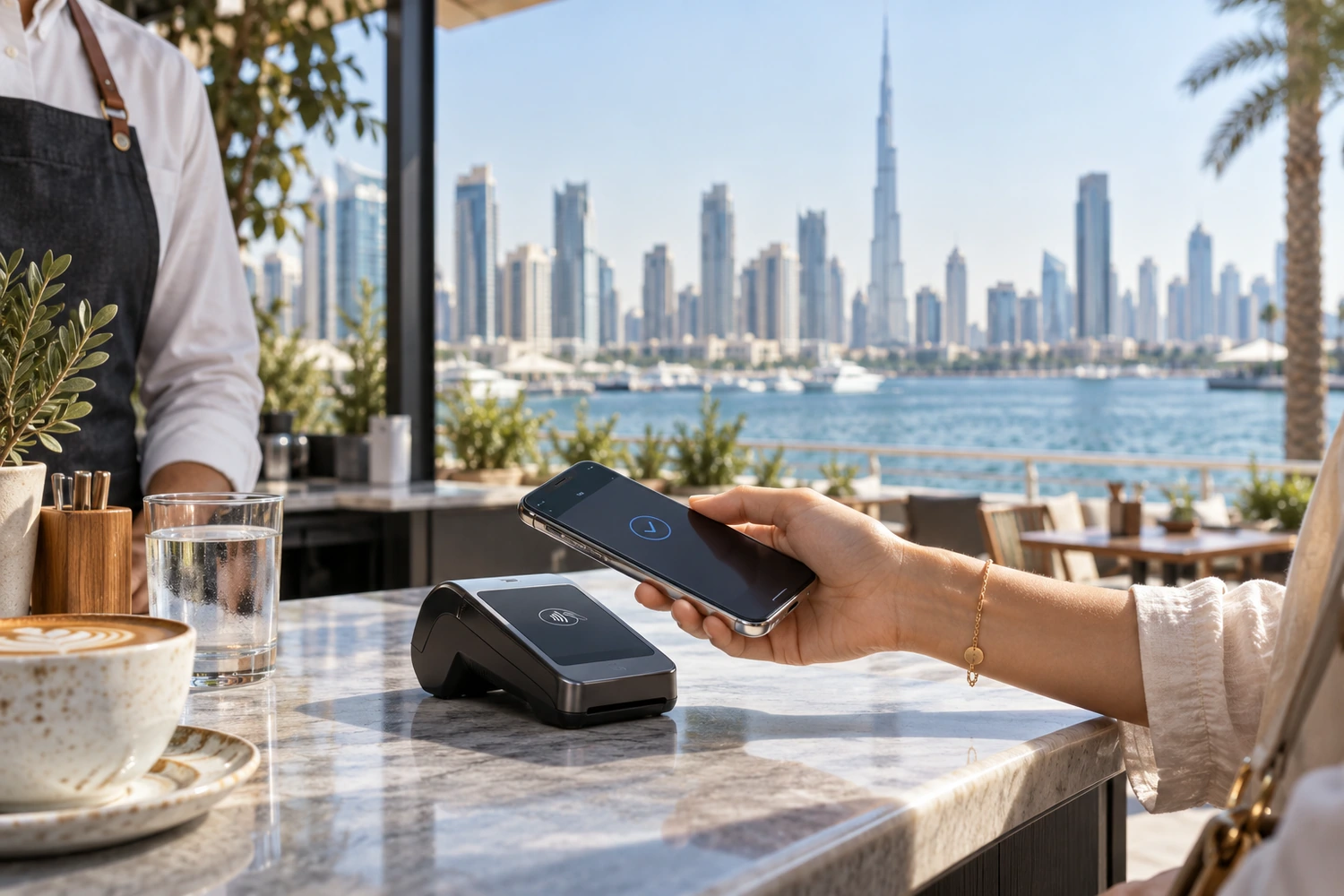
Published 16 October 2026. Official announcement dates and reporting periods are identified above. Featured image: AI-generated editorial illustration of a contactless payment in a Dubai-inspired waterfront setting; not a photograph of an actual transaction or the official announcement.
More stories

Discover what comes next
Explore our developments or speak with our team for more information.